
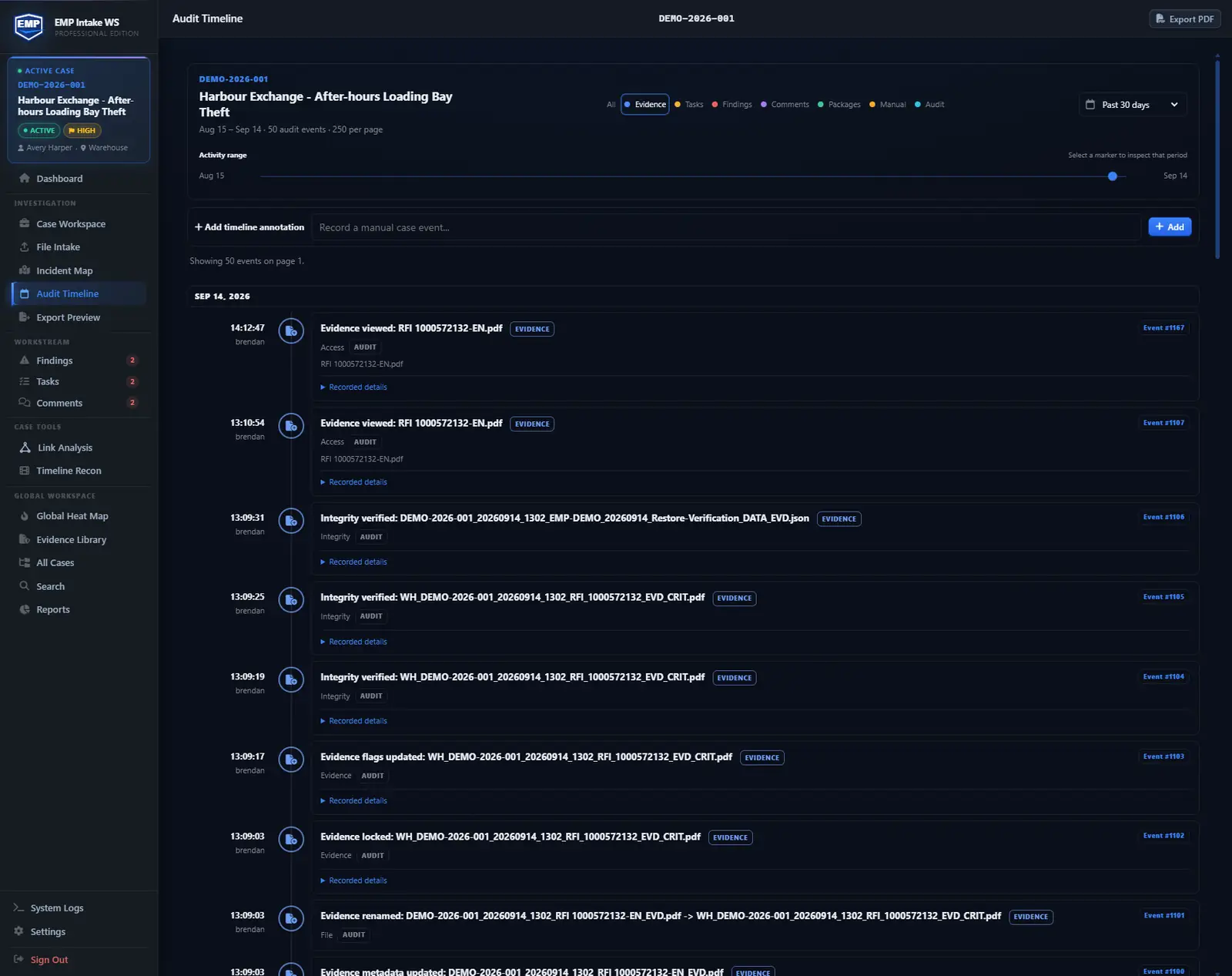
EMP Intake Teams applies evidence hashing, preserved originals and recorded handling to a shared workspace. Its pilot is planned for 2027 on infrastructure you control. This guide covers access, collaboration, audit records and deployment responsibilities.
1. The shared integrity model
Same objects as the standalone workstation: cases, evidence, custody events, packages, logs. Same evidence hashing, preserved-original, workflow-specific provenance, audit, and export-package principles. Recipients can review exported files and check their manifest without EMP installed. Included content and verification options depend on the export. The NIST SP 800-86 and 800-101 alignment carries over too, as a design target that shaped the build, not a certificate. SP 800-101 references concern handling and exporting mobile-device evidence acquired elsewhere, not extraction from a device.
2. What changes at team scale
The new problem is concurrency. Two investigators may open the same case. EMP shows section-level edit presence. For case details and notes, stale saves are rejected and the investigator's draft is preserved so it cannot silently overwrite a newer save. EMP does not stream live keystrokes between users. The Workspace API checks access and records supported actions with the acting user. Conflict protection depends on the editing workflow. An audit record is not a universal guarantee against conflicting edits.
3. Authentication, authorization, and encryption
Remote clients connect to the Workspace API over HTTPS. Local accounts and case permissions control access. Database transport and storage encryption must be configured and verified for your environment, with keys under your organization's control.
4. Audit-trail integrity under concurrency
Audit records are append-only through supported application workflows. Direct administrative access, retention and restore procedures remain part of your organization's controls.
5. Backups, DR, and case portability
Back up the case database and managed evidence files together, and verify recovery before relying on the backup. A case export is a hand-off artifact, not a replacement for a workspace backup.
6. Hardening and disclosure
Teams runs where your evidence already lives, so a lot of the posture is yours: network boundaries, IAM, key management, patching. We hand you the patterns we recommend and work through the environment-specific hardening with you. Formal third-party attestations and published penetration-test reports are not claims we make today.
Team security, worked through with you. EMP Intake Teams adds shared cases and role-scoped access on infrastructure you control, with the environment-specific hardening worked through together (pilot planned for 2027). Apply to the Teams pilot →