
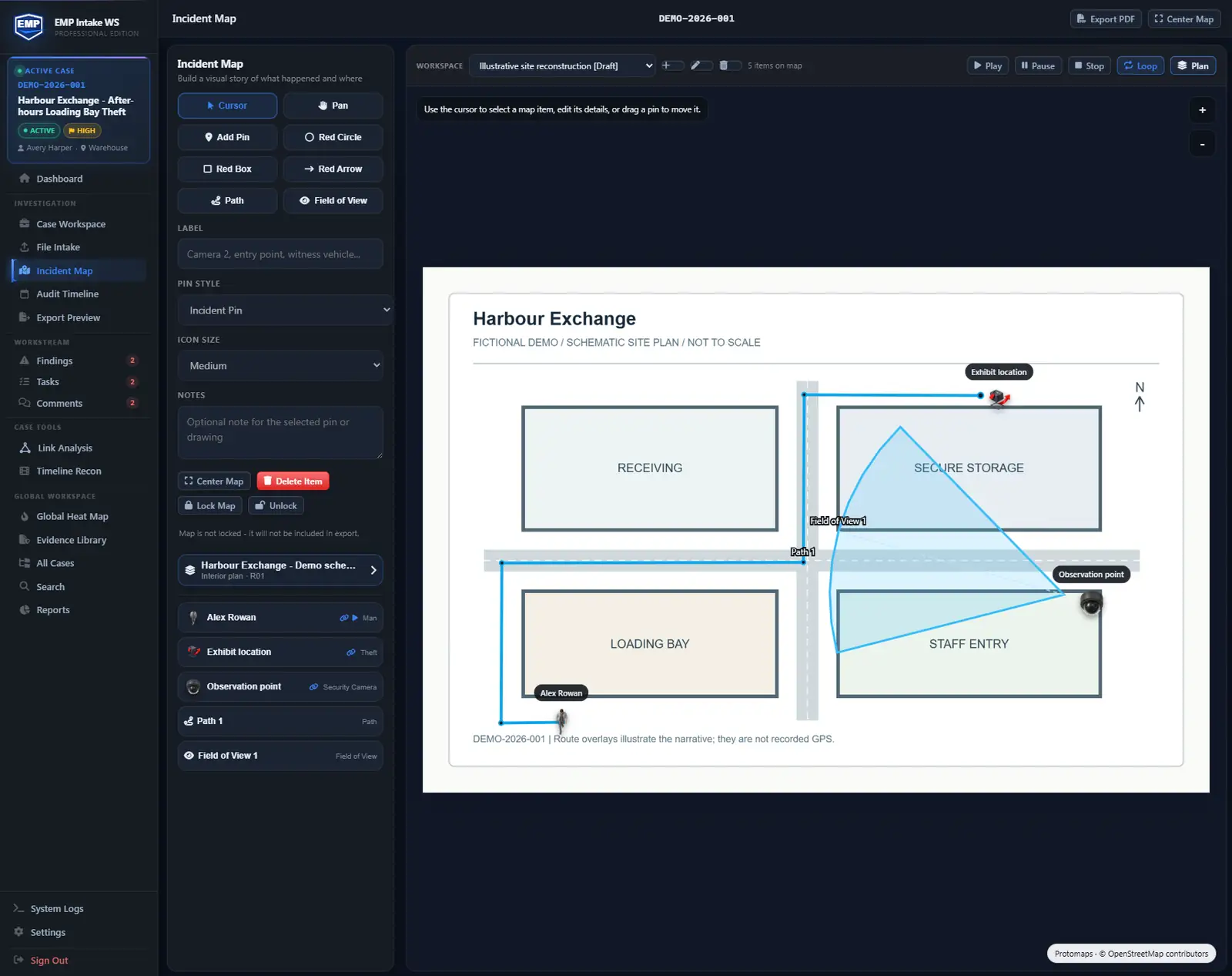
Pin cameras, response points, witness positions, and team-marked observations on a shared incident map, and narrate the scene with circle, rectangle, text, and arrow shapes. EMP Intake Teams loads OSM-derived Protomaps through a Falcrex-controlled map delivery service. Map requests carry standard connection information and the technical map-resource request needed to display the selected area, never evidence files or case content.
1. The shared incident map
In Teams, the incident map is shared across the team and edited by attributed team members with map-section presence for coordination. Camera and response pins, witness-position pins from interview transcripts, and the circles, rectangles, text, and arrows that mark movement and scope can all be placed by different people. Each pin and shape is attributed to the investigator who placed it, so the map is a single shared surface rather than a stack of separate working files.
2. Where the basemap comes from
EMP Intake Teams loads OSM-derived Protomaps through a Falcrex-controlled map delivery service using Cloudflare infrastructure, and only when the incident map is opened. Requests include standard connection information and the technical map-resource request needed to display the selected area. EMP does not send case numbers, filenames, evidence, pins, shapes, overlays, user identity, or license identifiers with map requests. Retrieved map resources may be cached locally on the client workstation. Pin placements, shapes, and case identifiers stay inside your boundary. Discuss offline map requirements when planning your pilot.
3. Attributed, non-destructive editing
Every pin and shape is an attributed object. Moving or editing a map item updates that item and appends an audit record containing the prior state and applied change. Removing an item removes the active map row and appends an audit record describing the removal. The audit trail is append-only, so reviewing parties can see who placed, moved, or removed what.
4. One shared case, not separate copies
The incident map and the timeline both belong to the same case in the shared workspace. In Teams, everyone reads the same pins, shapes, and reconstruction from one source, so a tabletop review works from one authoritative set of placements and one timeline instead of reconciling separate copies.
5. Exporting the map
The incident map exports as a PDF, with the view lockable to freeze its state in the export package. The Teams export carries the case audit trail, which records who placed and edited map items.
One map for the whole team. EMP Intake Teams keeps one authoritative set of pins and shapes with shared cases and role-scoped access, and attributes map actions in the case audit trail (pilot planned for 2027). Apply to the Teams pilot →