
EMP Intake Teams vs enterprise case management platforms.
Enterprise case platforms are mature, deeply specialized systems whose cost runs from published entry pricing to six or seven figures at scale. EMP Intake Teams has a pilot planned for 2027: multi-user evidence management on your own infrastructure, with every file copied, hashed, and tracked at intake.
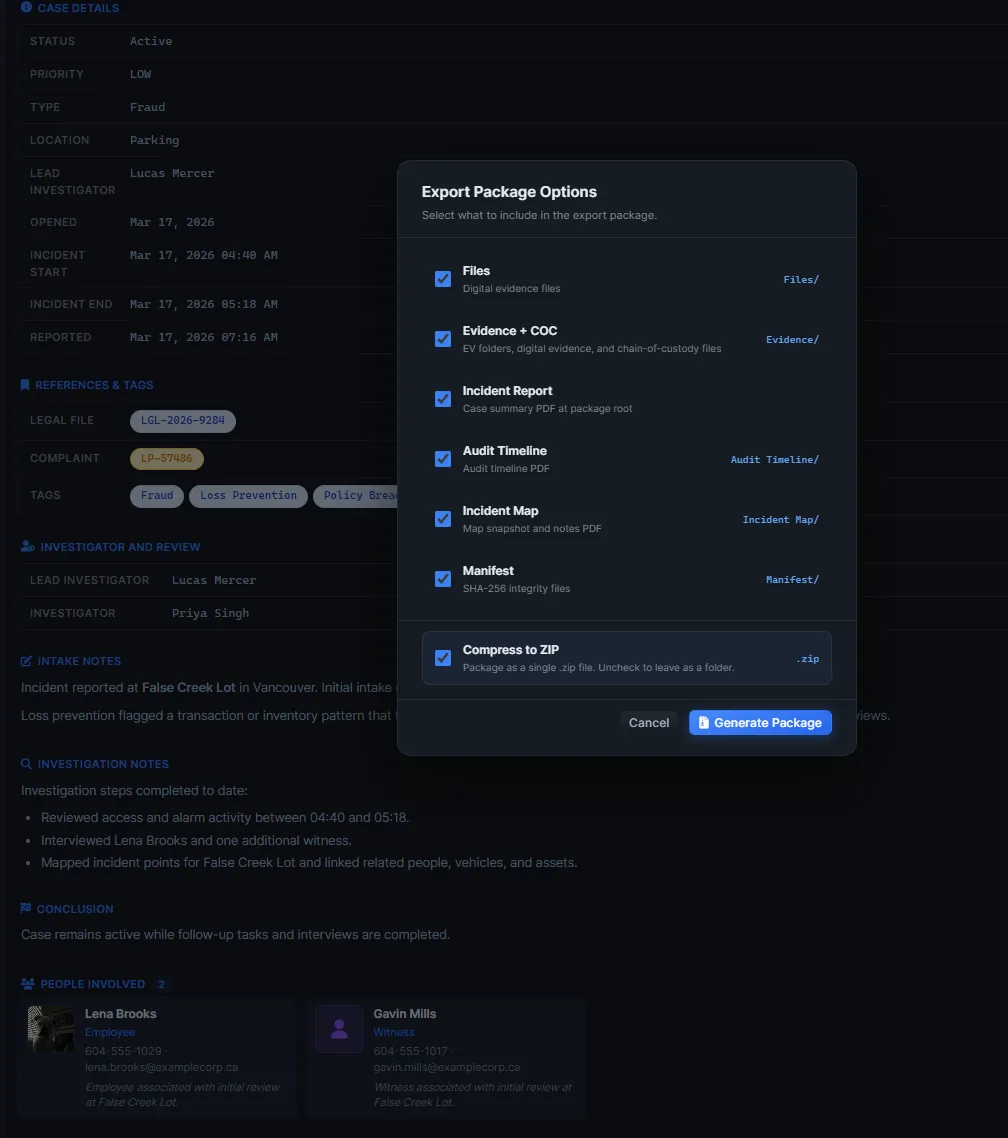
The enterprise case management category covers mature, deeply specialized platforms: analyst-grade link analysis, police records management, campus-conduct and Title IX workflows, full agency CMS deployments. EMP Intake Teams does not replace a mature enterprise platform on day one; its pilot is planned for 2027. What Teams offers is multi-user evidence management that runs on your own infrastructure: when a file enters a case, it gets copied and hashed on the way in, the original is preserved, and supported case and evidence actions are recorded with the responsible account and time.
Related: EMP Intake Teams, how it handles deployment on your own infrastructure, and the Teams security model, plus real pricing from public records.
How they compare
| Criteria | EMP Intake Teams | Enterprise platforms |
|---|---|---|
| Deployment & control | ||
| Deployment | Your infrastructure, PostgreSQL | Varies by vendor and tier: managed SaaS, private cloud, and self-managed options |
| Where case data lives | Inside your boundary | Varies by deployment and contract |
| Data sovereignty | You hold the data | Depends on the hosting model chosen |
| Integrity & rigor | ||
| Integrity model | Hash, originals, append-only audit | Built in, mature |
| NIST 800-86 / 800-101 | Design target, not certified | Varies by product |
| Verifiable export | Yes, no EMP needed | Varies, some proprietary |
| AI assistance | No built-in AI assistant claimed | Varies by product |
| Workflow & maturity | ||
| Workflow specialization | Evidence primitives, agnostic | Deep, purpose-built |
| Product maturity | Pilot planned for 2027 | Production at scale |
| Reconstruction views | Timeline, map, link analysis | Varies by module |
| Pricing & relationship | ||
| Licensing | Pilot terms agreed in writing | Varies: active users, modules, workspaces, implementation, or bespoke contracts |
| Cost | Contact us to discuss pilot scope and pricing | Public entry pricing exists for some products; larger deployments can reach six or seven figures |
| Time to deploy | Schedule agreed after reviewing your environment | Days to months, depending on scope, configuration, migration, security review, and integrations |
| Vendor relationship | Direct with co-founders | Tiered sales + support |
SP 800-101 references concern handling and exporting mobile-device evidence acquired elsewhere, not extraction from a device.
Updated 2026-08-23. The highlighted column is EMP Intake Teams, with a pilot planned for 2027.
Category rows describe typical patterns and vary by vendor, edition, and contract. The named-vendor comparison pages carry per-vendor sources checked on 2026-08-23.
Where each one wins
Where EMP wins
- On-prem or private-cloud deployment is a hard requirement for data-control or regulatory reasons.
- You need the multi-user discipline of a case-management platform but not the deep workflow specialization of an incumbent.
- Enterprise platform economics don't work for your team size, but a single workstation isn't enough.
- You want incident maps, link analysis, heatmaps, and timeline reconstruction in one place.
- You want EMP Intake's integrity model and reconstruction views extended to a multi-user workflow, with direct co-founder support.
Where they win
- You need deep workflow specialization: campus-conduct, police RMS, or analyst-grade link analysis tooling.
- You need a mature, production-deployed product today; waiting for a pilot isn't an option.
- You operate at a scale where an incumbent's operational maturity is a decisive advantage.
- Specific integrations matter, for example records-management or law-enforcement systems an incumbent already supports.
EMP is not trying to replace every enterprise case management system
Enterprise platforms are built for intake queues, approvals, hotline workflows, policy routing, HR or legal escalation, and organization-wide reporting. EMP Intake is narrower. It manages the local case file: the evidence, the people, vehicles, places, assets, notes, tasks, findings, audit trail, and export package around an investigation.
What EMP is not
- Not a managed cloud service. EMP is local-first and self-hosted.
- Not certified. NIST SP 800-86 is a design target, not a certification, and admissibility is the court's call.
- Not a forensic acquisition tool. EMP organizes and preserves what you already collected.
- Not an enterprise GRC or risk platform. EMP is narrower: evidence integrity plus the case workspace around it.
Competitor details here are drawn from public sources such as vendor websites and documentation, and can change. Verify current capabilities with the vendor. This comparison covers EMP Intake Teams. Confirm available features, deployment requirements and commercial terms for your pilot.
Frequently asked questions
Is EMP Intake Teams ready to replace an enterprise platform today?
No. The Teams pilot is planned for 2027; we're recruiting pilot organizations. The incumbents are mature, deeply integrated products. Teams is the right pick when you need multi-user evidence management that runs where your evidence already lives and keeps a visible record of what changed, without the operational and licensing overhead of a large enterprise platform.
When should we consider Teams over an enterprise platform?
The signals: you need on-prem or private-cloud deployment for control reasons; you don't need the deep workflow specialization of an incumbent; and a per-seat enterprise license is prohibitive for your team size while a single workstation isn't enough.
What is the Teams deployment model?
A customer-controlled PostgreSQL backend on your own infrastructure (LAN, on-prem, or private cloud), with role-scoped audit attribution and the same integrity model EMP Workstation carries: documented supported events leave an attributable record. Case data stays inside your boundary; documented egress is limited to license activation, update checks, and map-resource requests through a Falcrex controlled map delivery service using Cloudflare infrastructure when someone opens the incident map. Exact container specifics are confirmed with each pilot customer.
How does Teams pricing work during the pilot?
Contact us to discuss your users, infrastructure and pilot scope. Pricing, duration, support and transition terms are agreed in writing before the pilot starts.
See the difference for yourself
Try Workstation free for 14 days, with no credit card. For shared cases across PCs, discuss a Teams pilot.
About this comparison: it is based on publicly available materials as of August 2026, and products change. If anything here is out of date, email hello@falcrex.com and we will correct it. All third-party product and company names are trademarks of their respective owners. Falcrex Systems Inc is not affiliated with, sponsored by, or endorsed by any of them.